
Home Electrification and Getting Off Gas
In this post, our CEO Georgie Ferrari talks you through everything you need to know about home electrification: why you should bother, where to start, how to fund it and future policy solutions. Take it away, Georgie.
What is Home Electrification?
If you're a homeowner wondering when to retire gas appliances, what to switch to, whether to do it all at once or one at a time, how to fund it, and whether it's even worth it—you're not alone.
At Sustainability Trust, we've been operating in the home efficiency space for 23 years. Last financial year alone, we visited more than 7,500 homes in the Wellington region. Through this work, we constantly hear questions about electrification and know that many homeowners don't know where to start.
Home electrification means a fully electrified home—from the roof to the garage, the kitchen to the bathroom, with home battery backup included. That's the whole bundle, but it doesn't mean you have to do it all at once.
Let me cover five key aspects: why, what, when, will, and how.
Why Get Off Gas? Why Electrify Everything?
It's the Right Thing to Do for Our Environment
The power is literally in your hands. Rewiring Aotearoa makes the point that 31% of our domestic economy emissions relate to household energy—how you heat, eat, shower, drive, and power your home. They say:
"Electrifying these appliances and vehicles is likely to have a bigger impact on emissions reduction than any other decision households or businesses make. These domestic 'dinner table' decisions are an under-recognised opportunity to reduce New Zealand's emissions and meet our climate change obligations."
Gas is Bad
Gas is a fossil fuel that creates harmful atmosphere-heating emissions. What’s more, a recent EECA study has linked indoor pollution created by cooking with gas stoves with the early deaths of more than 200 New Zealanders a year. That same study associated more than 3,200 childhood asthma cases a year with the use of gas stoves, as well as hundreds of hospitalisations for respiratory and cardiovascular issues.
And if that doesn't convince you to ditch it, maybe this will: it's running out!
The Ministry of Business, Innovation and Employment has reported that our reserves are falling faster than previously estimated. We've got about 948 PJ left. At our current rate of consumption, that's about six years' supply left.
Gas prices will increase as supply falls. As Paul Fuge from Consumer NZ has said, this is especially true if we see a “death spiral effect”—as more households disconnect from gas, the cost of maintaining the gas infrastructure is spread across fewer users, pushing prices up further and encouraging even more to leave.
Consumer's advice was that when household gas appliances reached the end of their life, it made sense to replace them with an electric alternative. Fuge said 46% of households used gas of some type and he expected an average increase in gas prices of 10% this year.
Interested in learning more about the Government's latest move to import LNG? Check out this piece from RNZ’s Investigative journalist Kirsty Johnston.
Energy Resilience
Recent storms and weather events have starkly underlined the need for energy resilience or independence. Climate change means we will see more unpredictable and severe weather events.
Solar and battery systems, if installed to do so, can provide resilience by operating off-grid. This provides:
Backup power during outages: When an outage occurs, an intelligent inverter automatically disconnects the system from the grid, allowing your stored battery power to run designated "critical loads" without interruption. Users in New Zealand have reported that this feature kept essential items like lights, fridges, freezers, and communications running for days after Cyclone Gabrielle.
Self-sustaining power: Unlike a fuel-dependent generator, a solar-and-battery system can be self-sustaining during an extended outage. As long as the sun shines, the panels will recharge the battery, providing continuous, emissions-free power for days or weeks.
It Will Save You Money!
Let's not beat around the bush—all of the items we're talking about cost money upfront. I can't give you an accurate price for your home because all homes are different, and your needs are different. But the long-term savings are real, and I'll come back to this topic later in the piece.
What and When to Electrify?
What to Electrify?
This really depends on what you've got at the moment, what is nearing the end of its life, and your budget. You don't have to do it all at once!
What we know from EECA's research is that New Zealanders have aging domestic space heating and water heating products. At least a third of non-green home appliances are at least 10 years old, and about half are over six years old, meaning within the next five to 10 years they will be coming to the end of their natural life.
When these things break down, a quick decision is usually made to replace them because everyone wants hot water immediately. If it's winter and your heating source dies, you need it replaced quickly. The time to plan for electrification is now, even if you don't do it now.
Other things to consider:
If you're a high user of your car, swapping out a petrol or diesel vehicle for an EV or PHEV may be your best decision
Solar and battery may deliver the best value for your home immediately, depending on your energy consumption and roof suitability (i.e. north-facing)
When to Electrify?
Think about the lifecycle of your appliances and machines
Replace at end-of-life rather than rip out now
Solar and battery could be a top bet
Renovation is a great time to think about replacing appliances
There are no rules—one appliance at a time is fine if it suits your budget
There may be some benefit in doing things all at once if you can afford it (less disruption to the home and some cost efficiencies), but many people take a 5+ year approach to electrifying
Will It Save Me Money?
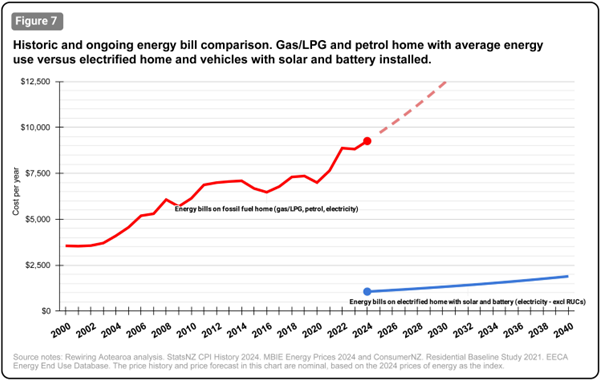
I really urge you to spend time on Rewiring Aotearoa's website—it's an excellent resource for every question you might have on home electrification. Their research shows the increasing cost of a household with average energy use where petrol, gas/LPG, and electricity are all in use versus that same home where it's completely electrified with solar and battery and an EV. The gap is stark.
How Do I Finance It All?
A back-of-the-envelope calculation for my own home—which is five bedrooms over three levels—for replacing my old gas central heating, adding rooftop solar panels, a home battery, and replacing my 90cm oven with an induction cooktop came to just under $80,000 for quality appliances. This doesn't include an EV.
If I had a lazy $80k lying around, my estimated payback, assuming $4k cost savings a year, is 20 years. If your house is smaller or requires less of an electrification overhaul, evidently your cost will be lower. But it’s still a big undertaking—how does one afford the upfront costs?
Current Options: Green Loans
Green loans with banks provide one solution, but they all have relatively short repayment timelines, usually three years. Taking my costs as an example: I borrow $80k from my bank at 1% p.a. for three years. The 1% interest rate is excellent and adds minimal cost (~$1,185 total), but the real challenge is the 3-year repayment period requiring $27,072 a year in upfront repayments when I'm only saving $4,000/year on energy to begin with. I need to find that extra ~$23,000/year from other sources to service the loan. You can see why people want to plan for electrification over a longer period and maybe take it one appliance at a time.
All major banks have green home loans, usually offering three years of capital at 1% p.a. We have listed all the offerings from the major banks in another recent blog post.
Other Things to Consider
Electricity is likely to get more expensive over the lifetime of the products
If you have rooftop solar and battery storage, your annual savings could increase significantly if you can use less from the grid
You're doing a major capital upgrade to your home, increasing its inherent value
It's only a matter of time before we see energy efficiency upgrades advertised as major selling points in the real estate market, as we already do when a home is double-glazed
You're making your home energy resilient and reducing your emissions—all good things to do!
Is There Another Way?
Yes! Rewiring Aotearoa is proposing a Ratepayers Assistance Scheme—where over a flexible period of 20 to 25 years, a loan could be taken out against the value of your property and paid back through your quarterly rates bill with an interest rate lower than current mortgage rates. The devil is in the detail, but this scheme is a great idea. It needs legislative change to get off the ground.
The Bottom Line
I firmly believe electrification is an idea whose time has come. Aotearoa is at the perfect tipping point—we've got the climate imperative, we've got the aging domestic products, and many of us have the will. We just need the financial and political levers to be pulled in our favour to make the switch.
I acknowledge that it's a complex topic. It's hard to know what to do and when, and there's a lot of contradictory advice. But the path forward is clear: plan now, replace at end of life, and take advantage of the financial tools available—whether that's green loans today or the proposed ratepayers assistance scheme tomorrow.
If you’re interested in chatting to our team about how we can help you electrify, please do reach out to us. We have over twenty years of experience making homes warmer, drier and more energy efficient in the Wellington region, with all profits reinvested into our community programmes.
Currently we offer supply and install of quality EV chargers, heat pumps, central heating and LED lighting, and we’re developing a broader offering of other products like hot water heat pumps and solar panels. Keep in touch via our newsletter to know as soon as we launch a new service to help you electrify your home.
The future is electrifying, and the time to start planning is now.